
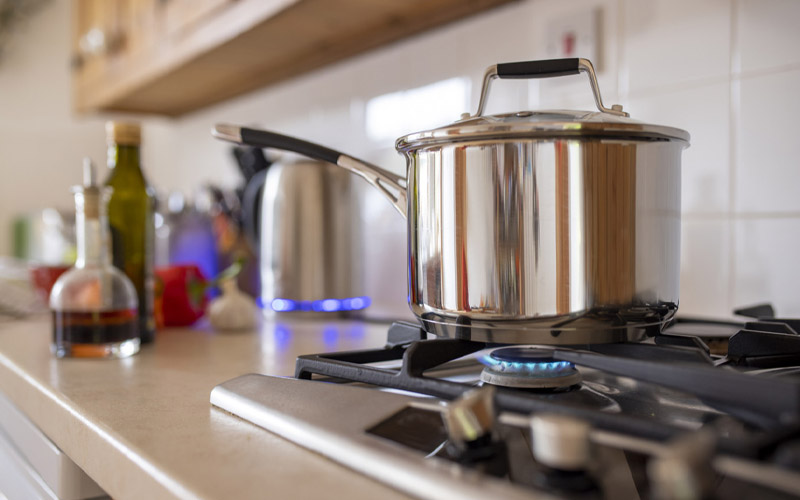
Who does not appreciate the gratification of turning on a burner and watching a flame instantly ignite, quickly warming your pan to the optimal temperature? We mostly use gas to cook; therefore, the latest headlines about a potential kitchen gas stove ban are worrying those of us who do.
Over 40 million houses in the U.S. have gas burners. Nevertheless, experts caution that using gas stoves might be detrimental to our health, and many believe it would be best if we all switched to other types of cooking. We asked three medical professionals to weigh in on the debate.
To learn more about their point of view apropos of the health dangers associated with owning a gas stove and how to reduce them, keep reading.
1. Air Pollution Is Partially Produced by Gas Burners
According to the California Air Resources Board, a natural gas stove burns natural gas, which can release nitrogen oxides, carbon monoxide, and formaldehyde.
ADVERTISEMENT
Professor of biology and ecology Steve Allison demonstrates why the discharge of contaminants into the atmosphere occurs when gas is burned.
If the stove is not properly vented, these pollutants accumulate within the house and can occasionally exceed the regulations for air quality. In fact, using a gas burner while cooking can cause indoor air quality to be worse than on a hazy Los Angeles day.
Even though you might not use your gas cooker very frequently, you still need to be concerned. Stoves may emit natural gas and emit airborne pollutants even after being switched off.
2. Gas Stoves Exposure Leads to Serious Outcomes
According to pain management specialist Randa Jaafar, using a gas stove might potentially be harmful to one’s health if the appropriate safety measures are not performed.
When gas is burnt, nitrogen dioxide is emitted into the air, which can lead to lung cancer and breathing problems including bronchitis and asthma. Published research linked the usage of gas stoves in the home to 13% of children’s asthma cases in America.
Particulate matter (PM), according to Jaafar, is another issue that might arise while using gas to cook. PM is a kind of air pollution made up of minute molecules that are generated during the burning of fuels. Lung cancer, heart problems, and bronchial asthma can all develop as a result of prolonged exposure to PM.
3. Gas Burners Raise the Risk of Carbon Monoxide Poisoning
Using a gas burner has additional negative health effects due to carbon monoxide emissions (CO). CO is a gas that is formed during the burning of fuels like gas and is odor-free and colorless. It can result in death if breathed, as well as migraines, fatigue, vomiting, and disorientation.
Gas stoves should not be a risk for CO poisoning when used appropriately, but they can be dangerous if there is a leak or other problem.
Laura Purdy, a doctor and consultant, explains that gas leaks can be difficult to find and pose a fire danger. Parents need to pay particular attention to the controls on their cooktops since it may be quite simple for kids to turn them on and start a gas leak without lighting the gas valve.
4. Adequate Ventilation Can Reduce Gas Burners’ Health Dangers
One technique to reduce the possible hazards of using a gas burner is to make sure that your kitchen has sufficient ventilation; you can do this by opening the window and running a blower when you cook.
The risk associated with having a gas stove in your home, however, cannot be entirely eliminated by ventilation, which is prompting some individuals to replace their home equipment. The ideal situation is to replace any gas-powered equipment in your home and operate it entirely on electricity.
You won’t have to worry about developing asthma, getting cancer, or having a home fire since you will have a better, cheaper cooking experience. Experts stress the significance of using the right safety measures, particularly a carbon monoxide detector if you utilize a gas stove.
ADVERTISEMENT
Do you also rely on a gas stove in your kitchen? Did you know about these hazards? Would you consider switching to electricity entirely?
ADVERTISEMENT